
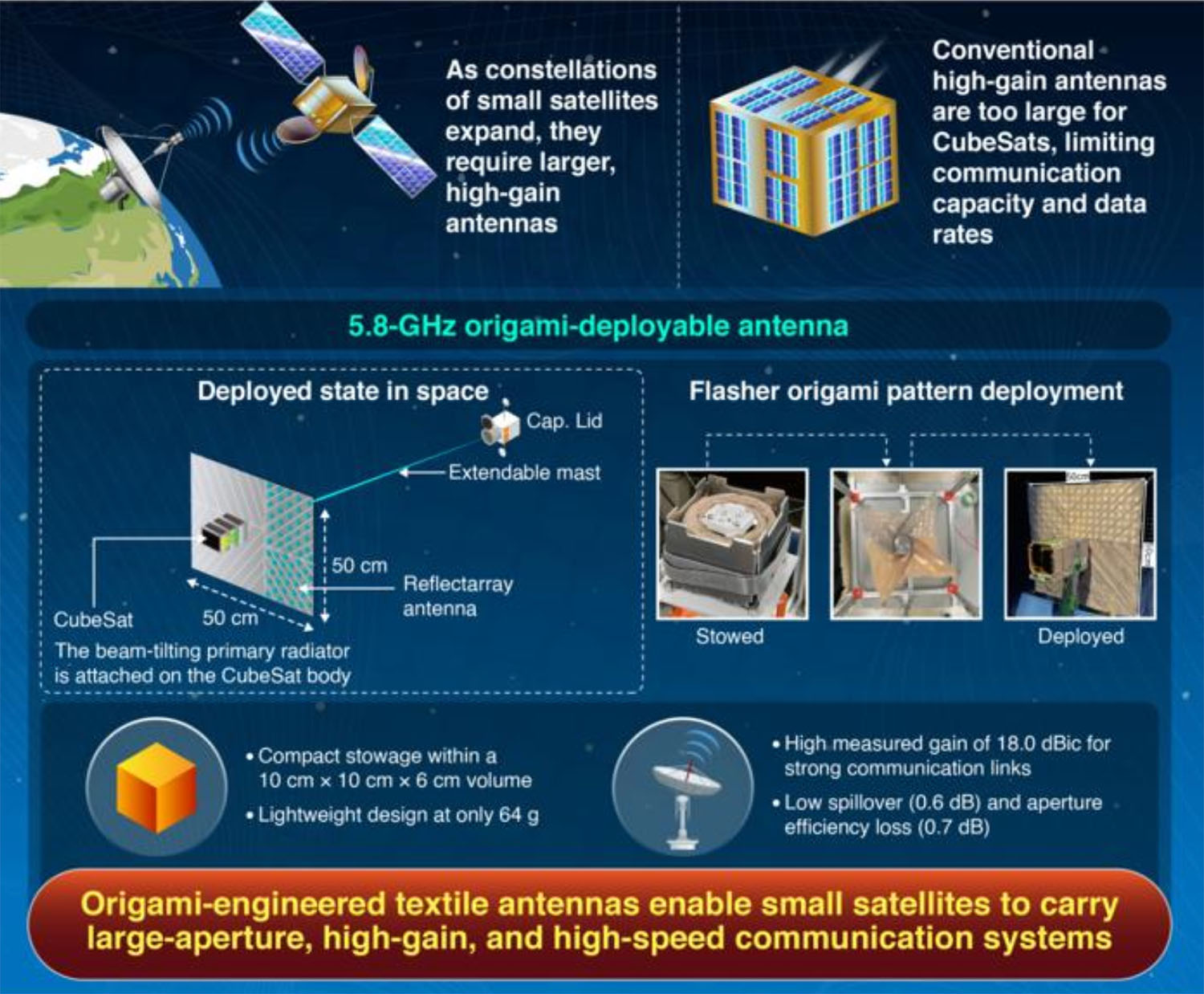
A team of researchers at the Institute of Science Tokyo (Science Tokyo), Japan, has developed a deployable reflectarray antenna that could significantly expand the communication capabilities of CubeSats. These compact, standardised satellites are increasingly used for low-cost space missions.
The antenna, designed for the university’s own OrigamiSat-2 spacecraft, uses a flasher origami folding pattern to compress a large radiating surface into a package measuring just 10 × 10 × 6 cm and weighing 64 grams. Once deployed in orbit, shape-memory booms expand the structure to 265% of its stowed footprint, providing enough aperture to achieve a high circularly polarised gain at 5.8 GHz.
That figure matters because antenna gain directly determines how much data a satellite can push through a communications link. Conventional high-gain antennas are too large and heavy for CubeSats, which typically measure no more than 10 × 10 × 34 cm and weigh 2 to 4 kg in a 3U configuration. Conventional antennas have been a persistent bottleneck, as small satellites capable of sophisticated sensing or imaging often cannot downlink data at the rates required for applications such as space-based internet services or real-time disaster monitoring.
Antenna construction
The antenna comprises a beam-tilting primary radiator that generates the radio signal and a reflectarray that directs it. The reflectarray is constructed from a flexible two-layer membrane of conductive and dielectric textiles, with U-shaped printed circuit elements sewn into place to control wave reflection. The beam-tilting primary radiator reduces signal loss due to structural obstruction, while the reflectarray elements convert linearly polarised signals into the circular polarisation required for reliable satellite links.
To fit the antenna inside a small satellite, the composite membrane is folded using a flasher origami pattern. The entire system can be compactly stored within a volume of just 10 cm x 10 cm x 6 cm and weighs only 64 grams.
According to the project leader, Associate Professor Takashi Tomura, “Our origami-inspired antenna can be compactly stowed and reliably deployed—critical for pre-launch qualification of CubeSat hardware.”
High-performance in a tiny form factor
Performance was validated in an anechoic chamber simulating free-space conditions, with the reflectarray element achieving a phase range of 280 degrees. In these tests, the antenna achieved a circularly polarised gain of 18.0 dBic, while the reflectarray element produced a circularly polarised reflection phase of 280 degrees.
“Our results show that even ultra-small spacecraft can carry large-aperture, high-performance antennas, greatly enhancing their communication capabilities,” says Tomura.
OrigamiSat-2 is scheduled for launch later this year. As more CubeSat missions are planned for the future, including some requiring communication to as far as the Moon, deployable antenna designs of this nature could play an important role in space exploration, a domain historically reserved for far larger and more expensive spacecraft.
The research was published in IEEE Transactions on Antennas and Propagation in April 2026.